15 Jul
2025
UCAT Preparation: A Medic's 8-Week Plan and Common Mistakes
What does it take to do well in the UCAT? Jessica sat the test in 2020, started Medicine at the University of Birmingham in 2021, and now mentors UCAT students at Oxbridge Solution. Here, she answers six common questions, from what the UCAT tests and how it's scored to the eight-week UCAT preparation plan she'd follow if she were sitting it again.
1. What is the UCAT, and how much does it matter for medicine and dentistry?
UCAT stands for University Clinical Aptitude Test. About 50 UK universities use it to select students for medicine and dentistry, and since the BMAT was scrapped, that includes Oxford, Cambridge, Imperial and UCL. Australia and New Zealand have their own version, the UCAT ANZ.
You sit it in the summer before you apply, usually between July and late September. You get one attempt a year, and your score only counts for that year's application.
Before interviews, the UCAT is the most important part of your application. Some schools barely read your personal statement at that stage. They rank applicants mainly on their UCAT, sometimes alongside grades, and invite the top of the list.
After that, the interview usually takes over. At many schools it alone decides the offer, though some keep weighing your UCAT alongside it. Either way, the UCAT is what gets you into the room.
2. What does the UCAT test, and how should you prepare for each section?
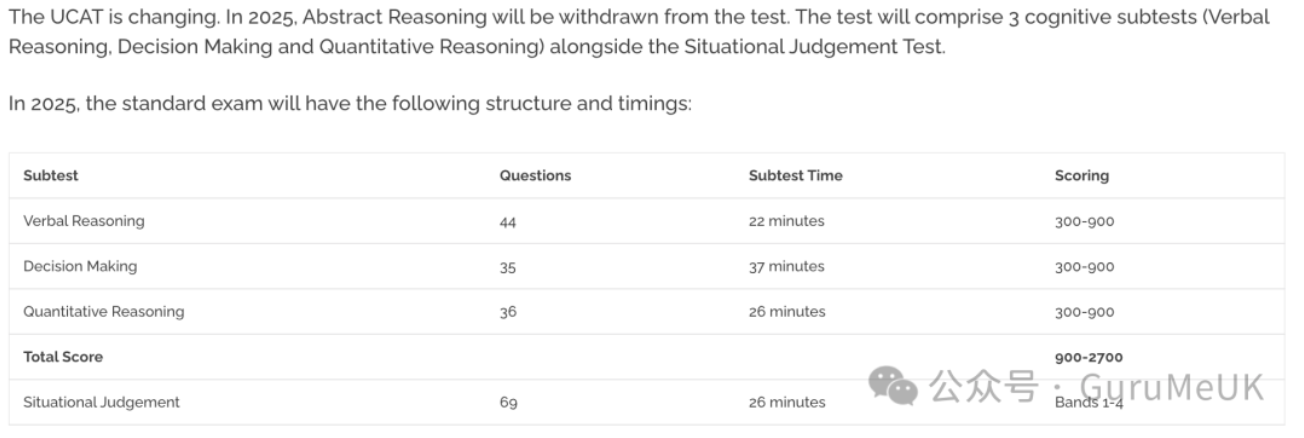
It doesn't test science. It tests how you think, across four multiple-choice sections taken on a computer in just under two hours:
- Verbal Reasoning: 44 questions in 22 minutes
- Decision Making: 35 questions in 37 minutes
- Quantitative Reasoning: 36 questions in 26 minutes
- Situational Judgement: 69 questions in 26 minutes
If a guide still mentions Abstract Reasoning, it's out of date. That section was dropped in 2025.
The real challenge is time
The content isn't the problem. The maths is GCSE level, and the reading is just reading. The clock is the problem: you get roughly 30 seconds per Verbal Reasoning question, just over 40 for Quantitative Reasoning, about a minute for Decision Making and about 22 seconds for each Situational Judgement question.
School doesn't train you for that. No A-level, IB or AP class teaches you to pull a keyword out of a dense passage in half a minute. Verbal Reasoning is where most people struggle, and in 2026 it had the lowest average of the three cognitive sections: 602, against 640 for Decision Making and 675 for Quantitative Reasoning.
So the most efficient preparation is the same for every section: learn the question types, then practise against the clock and study every mistake. Here's where each section catches people out.
Verbal Reasoning
There are 11 passages with four questions each, on anything from history to biology to a novel. Don't read every word. Read the question first, then scan the passage for its keywords, especially numbers, names, years and percentages, because that's usually where the answer sits. If you're a slow reader like me, the long-term fix is to read a lot. Your speed does come up.
Decision Making
This section tests logic, not decisiveness. The classic error is treating something the text only hints at as fact. If it's implied but never stated, you can't conclude it, so the answer is no. Work slowly at first, step by step, then speed up once you've found a method that suits you.
Quantitative Reasoning
The maths is easy. What slows people down is the on-screen calculator, so practise until using it is automatic: type numbers on the number pad with Num Lock on, and learn the keyboard shortcuts (Alt plus the underlined letter). And read the question and the table or graph before you calculate anything.
Situational Judgement
You'll read workplace scenarios and judge how appropriate or important different responses are. It can feel like opinion, but the scenarios follow patterns, and after enough practice you'll recognise what a good professional response looks like.
If English isn't your first language
Verbal Reasoning is harder when English isn't your first language. Unfamiliar words cost time, and time pressure in a second language makes panic more likely. But the gap is smaller than you'd think. Plenty of home students I've met at medical school found it the hardest section too, because finding keywords fast is hard for everyone. Read widely in English, from news to science writing to fiction, so vocabulary stops slowing you down.
Strong mental maths helps in Quantitative Reasoning, up to a point. Quick students tend to rush, grab the numbers and skip reading the question, and that costs marks when so many questions hinge on reading a table or graph properly.
3. How does your UCAT score affect your application, and what counts as a high score?
How it's scored
Verbal Reasoning, Decision Making and Quantitative Reasoning, the three cognitive sections, are each scored from 300 to 900, giving a total between 900 and 2,700. Situational Judgement is reported separately as a band from 1 to 4, with Band 1 the best. There's no negative marking, so never leave a question blank.
How universities use it
Each university uses the score in its own way. Some set a cut-off, some weigh it against your grades, and for some it only matters in borderline cases.
Don't treat the Situational Judgement band as an afterthought. More universities now use it, and some screen out the lower bands, so a great total won't always rescue a weak band. A low band doesn't make you a bad person. It means your judgement didn't match what's expected of a doctor or dentist, and you can work on that.
The upside is that you'll know your score before you apply. You get your score report before you leave the test centre, and the UCAS deadline for medicine and dentistry is 15 October, so you can pick universities that suit your result.
What counts as a high score
I'd aim for 2,200 or more with Band 1. That's a high bar. In 2026 the average total was 1,918. A score of 2,200 put you in roughly the top 15%, and 2,250 in the top 10%. Only 15% of candidates got Band 1.
4. How long does UCAT preparation take, and do you need Medify?
I'd give the UCAT six to eight weeks, which for most people means the summer holidays.
My 8-week UCAT study plan
- Weeks 1–2: untimed questions, to learn every question type.
- Weeks 3–4: timed practice, plus a proper look at each mistake: why you made it and which pattern you missed.
- Weeks 5–6: at least one full mock at the end of each week, to track your progress.
- Weeks 7–8: a full mock every day, so the real pace feels normal by test day.
Timing only comes in from week three, and that's on purpose: get accurate first, then get fast. And book your test early, so the date fits your plan rather than whatever slot is left.
Do you need Medify?
No, but I do rate it. It shows how many questions you've done each day, tracks your progress and gives you a predicted score, and watching that climb is motivating. For what you get, it's good value.
Not using it doesn't mean you're underprepared. Other platforms do a similar job, some for less, and the official UCAT website has free question banks and practice tests. Those won't track your progress or predict your score, so keep your own log. Use whatever you'll actually open every day.
5. What are the most common UCAT mistakes, and how can you avoid them?
- Not practising under timed conditions. This is the biggest one. You can understand every question type and still run out of time, so bring in the clock from week three and sit regular full mocks.
- Not learning from your mistakes. The UCAT leans on a fairly limited set of question patterns, so every error you properly understand saves time later and usually earns marks. For each one, note why you got it wrong and which pattern you missed.
- Leaving questions blank. There's no penalty for guessing. If you're stuck, choose your best answer, flag the question and come back to it if you have time.
- Fumbling the test screen. When a section's time runs out, a pop-up appears, and every second before you click OK comes out of your next section. The official practice tests mirror the real test screen, so use them to get comfortable with it before test day.
6. What can you do if your UCAT score isn't ideal?
You've got two options.
Apply strategically. Because universities use the UCAT so differently, a lower score narrows your choices rather than ruling you out. Read each school's admissions page, check whether it sets a cut-off and how much weight it gives the UCAT, and apply where your score works for you. You'll have your result before the 15 October deadline, so use that time to choose carefully.
Take a gap year and resit. You can only sit the UCAT once a year, and each score only counts for one application cycle. If you go this way, give yourself a longer run-up and fix whatever went wrong the first time.