24 Jun
2025
The 2025 UCAT Overhaul: Are Future Medics and Dentists Ready for the New Test?
If you're planning to study medicine, dentistry or another health science, take note: the UCAT underwent a major overhaul in 2025, and the 2026 test (for 2027 entry) has kept the new structure. The change affects not only what's in the test but potentially how you prepare for it and the mindset you bring to it. If you aren't properly prepared for these challenges, you could miss out on a place at your dream university. So what exactly changed in the 2025 UCAT, and what new challenges do these changes mean for you? This article takes a closer look and gives you a full picture of what the UCAT reforms mean.
What has changed
Abstract Reasoning has been dropped!
The most striking change in the 2025 UCAT reform is the removal of the Abstract Reasoning section. Until then, it had long been a key part of the UCAT, testing candidates' ability to understand and reason with visual patterns. However, years of data analysis showed that Abstract Reasoning had low predictive validity: it was less able than the other sections to predict how candidates would perform at university. The decision was therefore made to remove it and give more time to the other sections, particularly Decision Making.
The new test structure and scoring
Since 2025, the UCAT has consisted of the following four sections: Verbal Reasoning: 44 questions, 22 minutes, scored 300–900
Decision Making: 35 questions, 37 minutes, scored 300–900
Quantitative Reasoning: 36 questions, 26 minutes, scored 300–900
Situational Judgement: 69 questions, 26 minutes, graded in Bands 1–4. The whole test lasts nearly two hours and every section is precisely timed, so you need to use your time efficiently to get through each one. Abstract Reasoning may have gone, but the remaining cognitive subtests are more focused and more demanding.
Scoring compared with previous years
The total score range has changed from 1200–3600 to 900–2700, but scores for each subtest remain broadly comparable with previous years. UCAT uses standardised equating methods to make sure results from different years can be compared. Using the official materials, candidates can compare performance under the new three-subtest structure with previous results to understand how they are doing. Take the latest test, sat in 2026 (for 2027 entry): by 24 September 2026, the test had been taken 42,359 times, and the final average scores for the three cognitive subtests were 602 for Verbal Reasoning, 640 for Decision Making and 675 for Quantitative Reasoning, with an average total of 1,918. In Situational Judgement, 15% of candidates achieved Band 1.
Why it changed & how to prepare
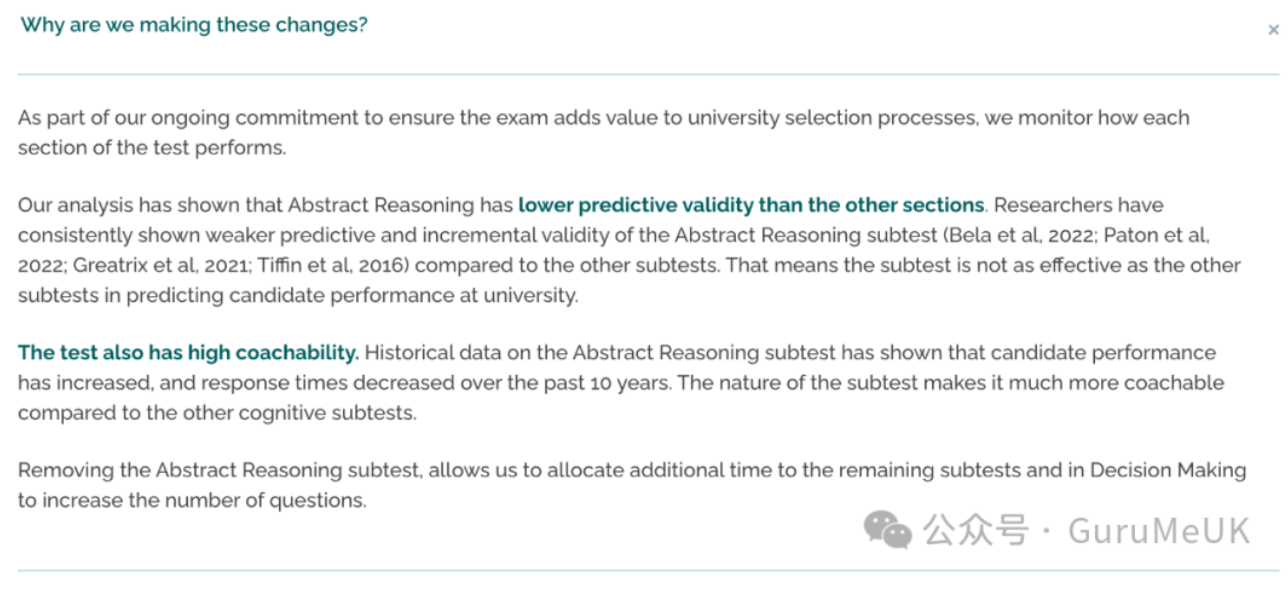
Why was Abstract Reasoning removed?
According to UCAT, Abstract Reasoning had low predictive validity, meaning it was relatively poor at predicting how candidates would perform at university. It was also highly coachable: candidates could raise their scores through targeted training, which called into question how well it measured their true ability. Removing Abstract Reasoning has allowed UCAT to focus more time and resources on the other subtests, particularly Decision Making, which now has more questions, giving a more rounded assessment of candidates' cognitive abilities.
How should you prepare for the new UCAT?
1. Focus on the new three-subtest structure. The new UCAT structure introduced in 2025 means your preparation should concentrate more on Verbal Reasoning, Decision Making and Quantitative Reasoning. For these sections, you need a deeper grasp of exam technique, as well as greater speed and accuracy.
2. Make full use of the official preparation materials. UCAT strongly recommends that candidates use its official practice materials, which have been updated for the 2025 test structure.
3. Improve your time management. The new structure requires you to work efficiently through each section within the time allowed. In Decision Making in particular, you have to answer 35 questions in 37 minutes, which calls for efficient time management and sound decision-making. Plenty of mock test practice will help you answer more quickly and accurately on the day.