12 Jun
2022
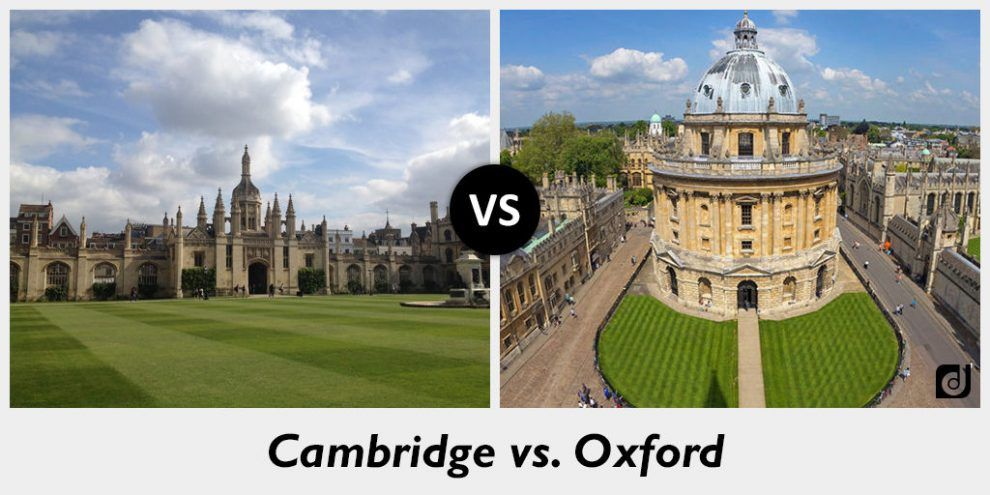
Oxford or Cambridge?
It’s a tough choice. But we’re here to help you out. There are many factors to consider, including the nature of the course offered, the ability to attend an interview in your home country as well as the likelihood of being admitted to your desired course.
Courses offered
One major criterion is whether the university offers a course which you’re interested in. You should bear in mind that the courses offered at Oxford and Cambridge may be different. You won’t always find the same course being offered at both universities. In relation to that, two main observations can be made:
1) The courses at Oxford often involve joint degrees. For example, prominent joint degrees at Oxford include:
PPE (Politics, Philosophy and Economics)
E&M (Economics & Management)
Mathematics & (Computer Sciences or Philosophy, Statistics)
History & (Economics, English, Modern Languages, Politics)
On the other hand, Cambridge tends to offer single degrees. That is not necessarily a disadvantage. If you look closely at the course contents, you’ll find that the Cambridge courses can provide exposure to a broad spectrum of different but related disciplines. For instance:
Natural Sciences - this course allows you to select topics from different fields or specialise in one particular area in the later part of your degree
Mathematics - students taking this course will be allowed to take Physics related modules from the second year onwards
Computer Sciences - students are allowed to take Mathematics related modules
2) There are a few courses which are offered at one university but not the other. Examples of courses offered solely at Cambridge include Architecture and Environment, Law, and Economics (previously called Land Economy).
Interviews for International Applicants
Interviews are an integral part of the Oxbridge admissions process. Oxford now holds all of its interviews online in December, so international applicants do not need to travel to the UK.
Cambridge interviews also take place in December and may be online or in person in Cambridge, depending on the College and course; most Colleges interview applicants based outside the UK online.
Please bear in mind that the interview arrangement varies across subjects as well, so for more information about alternative interview arrangements, do read the Degree Specifics section.
Chances of Being Shortlisted for Interview
Generally speaking, Cambridge tends to invite a higher proportion of its applicants to its interviews. Therefore, students who are relatively more eloquent can consider applying to Cambridge, where your oral communication skills can help you stand out during the interview.
Grades Required When Making an Application
Cambridge puts more emphasis on academic test grades. After submitting your UCAS application, Cambridge applicants must also complete My Cambridge Application (which replaced the SAQ; COPA has been discontinued), and international applicants usually need to provide a transcript of their results. This is not required for Oxford applications.
Conditional Offer Requirements
After a successful interview, the colleges will most likely make you a conditional offer with certain grade requirements. Cambridge tends to request higher grades than Oxford
| A-Level | IB | |
| Cambridge | A*A*A | 41-42 |
| Oxford | A*AA | 38-40 |
*Average conditional offer grades/ the actual may differ depending on the specific course
What happens if you don’t meet them? Sometimes the university will still admit you to the course, but it depends. For IB students, achieving a score of 42 is a common requirement. This can be very challenging. It has been observed that the number of applicants who failed to meet the IB score but still got admitted to their course tends to be higher for Oxford. In this regard, it seems that Cambridge imposes stricter conditional offer requirements.