16 Aug
2022
LNAT
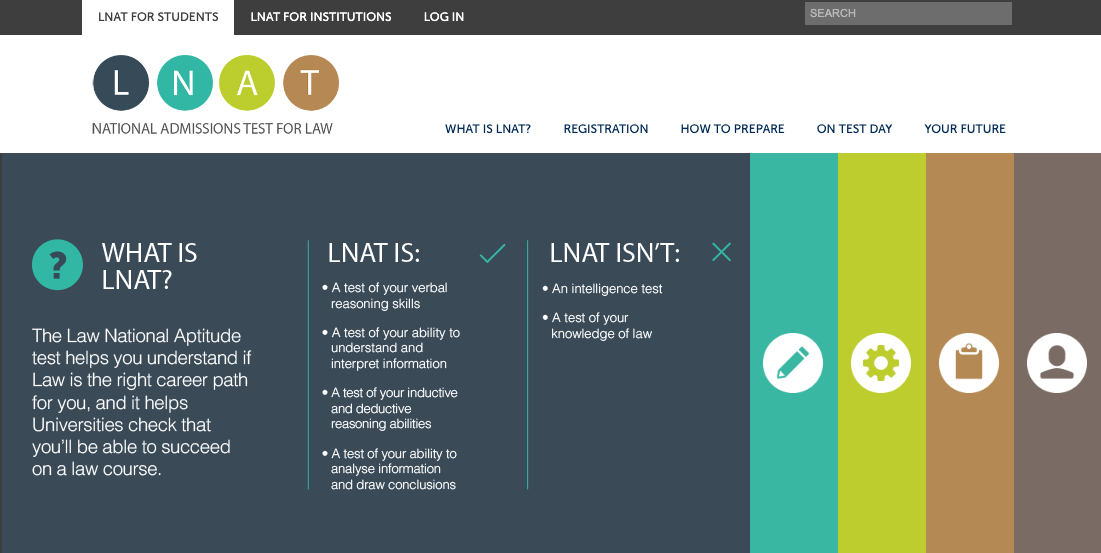
<p><strong>Introduction</strong></p><p> </p><p>The LNAT (National Admissions Test for Law) exam is an admissions test which students applying to read law need to take. Students register for the LNAT by creating an account with <a target="_blank" rel="noopener noreferrer" href="http://www.lnat.ac.uk">www.lnat.ac.uk</a>. The list of authorised LNAT test centres can be found at: <a target="_blank" rel="noopener noreferrer" href="https://wsr.pearsonvue.com/testtaker/registration/SelectTestCenterProximity/LNAT/348186">wsr.pearsonvue.com/testtaker/registration/SelectTestCenterProximity/LNAT/348186</a></p><p> </p><p>Note that not every university requires the LNAT. Here are some of the major ones which do: Bristol, Durham, KCL, LSE, Nottingham, Oxford, UCL</p><p> </p><p><strong>General Deadlines (If starting university in 2019)</strong></p><p> </p><ul><li>Registration for the LNAT begins: 01 Aug 2018 </li></ul><p> </p><ul><li>Oxford deadline for LNAT registration: 05 Oct 2018 </li></ul><p> </p><ul><li>Oxford deadline for taking LNAT: 20 Oct 2018 </li></ul><p> </p><ul><li>Standard deadline for LNAT registration: 15 Jan 2019</li></ul><p> </p><ul><li>Standard deadline for taking LNAT test: 20 Jan 2019</li></ul><p> </p><p> </p><p><strong>LNAT Format</strong></p><p> </p><p><i>Section A - MCQ</i></p><p> </p><p>This section has 42 multiple choice questions. It is meant to test candidates on a variety of skills, including the ability to: </p><p> </p><p>a) process large amounts of complex information under time pressure; </p><p> </p><p>b) identify key sections that correspond to the questions asked; </p><p> </p><p>c) question assumptions within a particular argument; and </p><p> </p><p>d) determine whether one point flows logically to the next or if it is a non sequitur </p><p><br> </p><p><i>Section B - Essay</i></p><p> </p><p>This section contains three essay questions from which students pick one to write on. Anything beyond 750 words will be ignored. Essay topics are typically quite diverse, ranging from terrorism to religion or the environment. Unlike the MCQ section, LNAT essays are not centrally marked. Instead, they are sent to the respective universities which you applied to. Your LNAT essays will be graded but you won’t know the score.</p><p><br> <img src="https://oxbridge-blogs-1.s3.ap-northeast-2.amazonaws.com/84mXvQUlHPe4u5x5dhjF.png"></p><p> </p><p><strong>Preparing for the LNAT MCQ</strong></p><p> </p><p>Getting enough practice is key to tackling the MCQ section. You will only have 95 minutes to answer 42 questions, which works out to about 2 minutes per question after deducting the time needed to read the passages. So getting used to answering questions under time pressure is key. </p><p> </p><p>There are quite a few LNAT assessment book in the market with plenty of practice questions for both the MCQ and essay components of the LNAT. Often, they can also be borrowed from a library. </p><p> </p><p>Do not worry if your initial attempts at the LNAT do not result in very high scores. The LNAT is difficult but students are not expected to achieve full marks. The average MCQ score for successful applicants is only about 28 out of 42. LNAT past papers can be located at: <a target="_blank" rel="noopener noreferrer" href="http://www.lnat.ac.uk/how-to-prepare/practice-test/">www.lnat.ac.uk/how-to-prepare/practice-test</a>.</p><p> </p><p><strong>Preparing for the LNAT Essay</strong></p><p> </p><p>In terms of the essay, there are two areas which you can work on: content as well as structure. Students are often told that the LNAT does not assess them on content. Even the LNAT website says so. And it is true. If you do not have any specialised knowledge in a particular subject area, you will not be penalised. But what most people forget is this. </p><p> </p><p>When you have a solid understanding of a particular subject, you can make very persuasive arguments. Because the content of the LNAT essay questions can be quite varied, it is often difficult to prepare in advance unless you work with a tutor who is familiar with the LNAT. Nonetheless, a good grasp of current affairs will definitely be to your advantage and reading the Economist as well as the Guardian can provide you with good examples which you can use in your essay. </p><p> </p><p>Bear in mind that you are restricted to 750 words for your essay. This means that quality is more important than quantity. Focus on writing three concise and well substantiated content paragraphs. </p><p> </p><p>Structure is an area in which you can definitely score points in. Do not underestimate its importance. Your examiner has to read through multiple applications. He or she can get tired and lose track of your arguments if you don’t make it easy for them to follow. Start with an introduction followed by three solid content paragraphs, then summarise the key arguments in your conclusion.</p><p> </p>